Your lawn needs mowing. Shrubs are crowding the walkway. The patio needs cleaning. An old stump keeps getting in the way. Then winter arrives, and snow removal becomes another name, number, schedule, and invoice to track.
The work itself is only part of property maintenance. The other part is managing the people doing it. Every added contractor can mean another estimate, another calendar, and another explanation of how the property should be handled.
For homeowners, seasonal property owners, and commercial property decision-makers in Ellison Bay and Door County, working with one company for all property maintenance can make outdoor care easier to organize when that company covers the services the property actually needs.
Key Takeaways
- One property maintenance company can reduce the time spent coordinating separate outdoor service providers.
- The real value comes from clearer communication, property familiarity, and better seasonal planning, not from assuming one company performs every trade.
- Written scopes still matter. Each task, work area, timing expectation, and exclusion should be clear before work begins.
- The best fit is a provider whose actual service list matches your recurring, seasonal, and improvement needs.
What Does “One Company for All Property Maintenance” Actually Mean?
Using one company for all property maintenance means consolidating compatible outdoor services under one accountable provider instead of finding a separate contractor for every task. The point is not that one crew can literally perform every trade. The point is that more of your property care can be managed through one clear relationship.
Outdoor work usually falls into recurring, seasonal, or project-based needs. Buildium’s 2026 property maintenance services guide uses the same broader idea of organizing maintenance by category instead of treating every request as an isolated job. Defined responsibilities make maintenance easier to plan.
For Ashley’s Property Maintenance LLC, this idea applies to outdoor property care. Its published services include landscaping, lawn care, landscape maintenance, mulching, plantings, stump grinding, patios and retaining walls, pressure washing, and snow plowing.
Why Does Juggling Multiple Contractors Create More Work Than It Seems?
The inconvenience rarely comes from one phone call. It comes from repetition.
More Scheduling Decisions
Every vendor has a separate calendar. Even small jobs can require confirmations, access arrangements, weather changes, and rescheduling.
When several services affect the same property, you become the person responsible for making those calendars work together.
More Repeated Communication
New contractors need context about gates, work zones, parking, planting beds, access points, and areas that should be avoided.
The more companies involved, the more often the same property details may need to be explained.
More Fragmented Accountability
When work areas overlap, it can become harder to know who should handle the next step or correct a problem that sits between two scopes.
Clear individual scopes help, but fewer handoffs can make responsibility easier to understand.
More of Your Own Time
Property care already takes time before contractor coordination enters the picture.
According to the 2025 American Time Use Survey from the U.S. Bureau of Labor Statistics, people who performed lawn and garden care spent an average of 1.90 hours on that activity on the days they did it.
Hiring professional help can remove physical work from your schedule, but several unrelated providers can replace some of that burden with scheduling, calls, and follow-up.
What Changes When One Company Handles More of the Outdoor Property?
A single property maintenance relationship can make the process easier to follow because fewer parts live in separate conversations.
| Property Care Issue | Several Separate Contractors | One Multi-Service Property Company |
| Point of contact | Different contact for each service | One primary company for covered work |
| Property history | Re-explained to each provider | More context can carry from job to job |
| Scheduling | Several calendars to coordinate | Related work can be discussed together |
| Service boundaries | More handoffs between companies | Clearer coordination within the approved scope |
| Seasonal planning | Services booked separately | Upcoming needs can be reviewed together |
| Specialist work | Separate specialist when required | Specialist still used when work falls outside scope |
The last row matters.
“One company” should never mean pretending one provider is qualified for work it does not perform. The better model is one primary partner for the outdoor services it actually offers, with specialists used when a job requires another trade or technical scope.
When Does One-Company Property Maintenance Make the Most Sense?
When Routine Care Keeps Multiplying
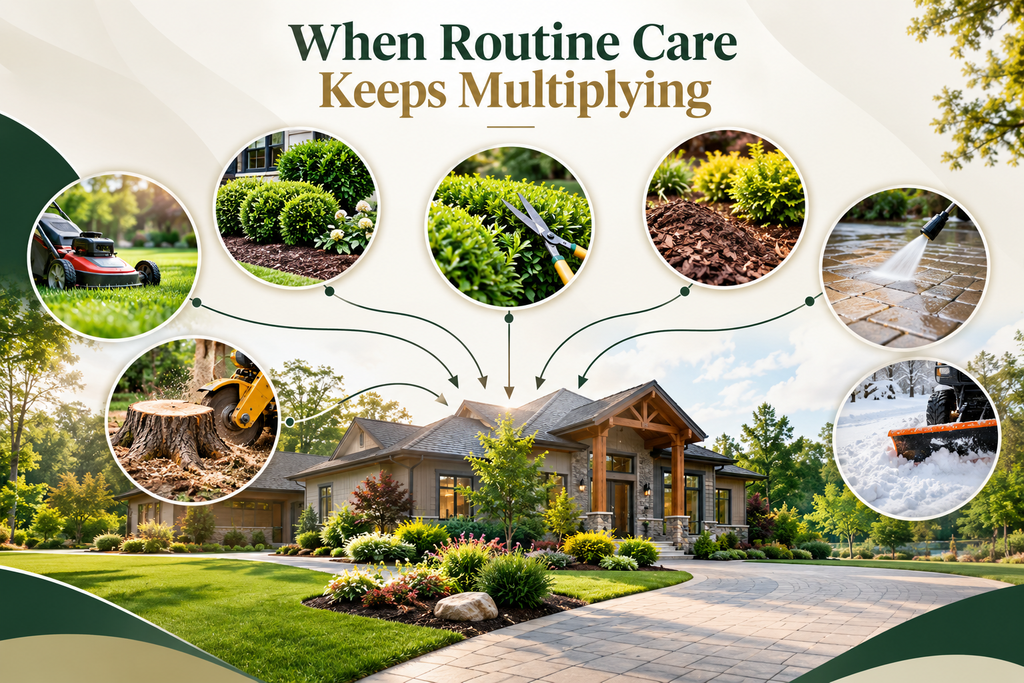
Mowing may be the first recurring need, but outdoor properties rarely stop there.
Beds need cleanup. Shrubs need trimming. Mulch fades. Surfaces collect buildup. Stumps interfere with how the yard is used. Snow eventually affects access.
When several of those needs fit one provider’s service list, fewer vendor relationships can mean less coordination.
When the Property Is Seasonal
A seasonal Door County property may not be checked every day.
A local company that already knows the property can make routine communication more practical because the basic layout, access points, and previous work do not always need to be introduced from the beginning.
When a Business Exterior Needs Consistent Attention
Commercial properties may have lawns, planting beds, walkways, outdoor surfaces, and winter access to manage.
One main contact can simplify coordination while still allowing each individual service to have a clearly defined scope.
When Maintenance and Improvements Affect the Same Space
A lawn, planting bed, stump, patio, retaining wall, and nearby surface are connected parts of one property.
A provider familiar with the wider site can discuss how one project may affect access, appearance, or future maintenance instead of considering every task in isolation.
An Illustrative Door County Scenario
Imagine a seasonal property that starts spring with overgrown beds and a lawn that needs routine care.
By summer, the owner wants fresh mulch and new plantings. Later, an old stump must be addressed before another outdoor improvement. Before winter, snow plowing becomes the next priority.
With separate contractors, each job starts with a new search, property explanation, estimate, schedule, and follow-up.
With one company covering those specific services, the owner can discuss the property as a sequence instead of a stack of unrelated jobs.
The work still needs clear estimates and approved scopes. The difference is fewer unnecessary handoffs.
Use the One Contact, Clear Scope, Seasonal Continuity Rule
This three-part rule can help you decide whether consolidated property care is a good fit.
One Contact
Choose a provider with a clear communication path for the services it performs.
You should know who to contact and how estimates, scheduling, and changes are handled.
Clear Scope
Do not treat “property maintenance” as a blank check.
Each service should define the approved work areas, requested tasks, access requirements, timing, and exclusions.
Seasonal Continuity
Look beyond the task in front of you.
Ask what the property is likely to need next season and whether the same company already performs that work.
If all three parts are present, consolidation can be useful. If the provider lacks a needed service or the scope is vague, a specialist may be the better choice.
What Should You Check Before Consolidating Property Maintenance With One Company?
Convenience should come after fit. Use these steps before moving several services under one provider.
- Match the service list to the property. Write down the recurring, seasonal, and project work you expect, then compare it with the provider’s published services.
- Ask for a property review. An estimate should reflect the actual work area, access, condition, and requested result.
- Define the work in writing. Wisconsin DATCP’s home improvement consumer guidance gives direct advice: “Do not rely on oral agreements.” Written details give both sides a reference point for the job.
- Check applicable requirements. For work covered by Wisconsin home improvement rules, review relevant contract provisions, insurance information, permits, and consumer protections.
- Ask how future work will be added. New services should be discussed with their own price, timing, scope, and approval.
The goal is not to skip due diligence. It is to build a dependable relationship with a provider that can cover several real needs well.
What Do Most People Get Wrong About “One Company” Property Care?
Mistake 1: Assuming One Company Should Do Literally Everything
Property maintenance can touch specialized trades that require different expertise or credentials.
Do This
Consolidate services that genuinely fit one provider’s published scope.
Not That
Push unrelated or regulated work into the same relationship only for convenience.
Mistake 2: Comparing Only the Cheapest Line Item
A low price for one task does not show how much time you may spend arranging access, following up, coordinating schedules, or resolving missed handoffs.
Compare scope clarity, reliability, communication, and fit with likely future needs instead of looking only at the first quoted price.
Mistake 3: Letting “Full Service” Replace a Written Scope
Broad labels are useful, but the actual job still needs details.
Wisconsin consumer guidance recommends written agreements and clear descriptions for applicable home improvement work. Clear documentation matters whether you hire one company or several.
How Does Ashley’s Property Maintenance Fit the One-Company Approach?
Ashley’s Property Maintenance LLC brings recurring outdoor care and property improvement services together for residential and commercial properties in Ellison Bay and across Door County.
Its property maintenance services in Ellison Bay, WI include lawn and landscape care, plantings, stump grinding, patios, retaining walls, pressure washing, and snow removal.
For established beds, shrubs, gardens, trimming, pruning, cleanup, and seasonal care, Ashley’s also provides dedicated landscape maintenance services.
That mix matters because upkeep and improvements often affect the same space. A lawn may need routine care while a stump limits future use, then winter shifts attention toward access.
The benefit is not that every service must become one package. It is the option to start with the whole property, then define the right work one service at a time.
How Can You Plan Property Care Across the Year?
Start with the property, not a generic calendar. Door County weather, plant growth, property use, surface condition, access, and your priorities all affect timing.
Spring may center on cleanup, lawns, mulch, plantings, and delayed projects. Summer often shifts toward mowing, trimming, pressure washing, and improvements. Fall brings cleanup and pre-freeze work. Winter puts snow access at the front of the plan.
For more on recurring outdoor care, read Ashley’s guide on why regular lawn care and landscape maintenance matter year round.
For surface cleaning and winter access, the related article on the benefits of pressure washing and snow removal for property safety covers those seasonal concerns in more detail.
The important part is continuity. When one company already understands the property, the next conversation can begin with more context than the last.
Final Thoughts: Fewer Contractors, Clearer Property Care
Property maintenance gets harder when every need becomes a new search, a new estimate, and a new relationship to manage.
Using one company for all property maintenance can reduce that friction when the provider’s real service list matches the work your outdoor property needs. You gain one main relationship, more continuity from season to season, and fewer handoffs between routine care and improvement projects.
The right choice still depends on clear scope, reliable communication, and specialists when a task falls outside the company’s services.
If your lawn, landscape, outdoor surfaces, improvement projects, or winter access are starting to feel like separate problems with separate contractors, it may be time to look at the property as one connected plan.
Ready to Simplify Your Property Care?

If several outdoor needs are competing for your time, Ashley’s Property Maintenance LLC can review the property and discuss which services fit.
Share the areas that need attention, your priorities, and seasonal concerns so the scope can be defined clearly.
Call 920-412-8204 to request an estimate for qualifying residential or commercial work in the confirmed service area.
Frequently Asked Questions
Is It Better to Hire One Property Maintenance Company or Several Contractors?
One company can be easier when several needs fall within the same provider’s real service scope. You may spend less time scheduling and repeating property details. Several contractors still make sense when you need specialized work that the primary provider does not perform.
What Services Can One Property Maintenance Company Handle?
The answer depends on the company. Ashley’s published outdoor services include landscaping, lawn care, landscape maintenance, mulching, plantings, stump grinding, patios and retaining walls, pressure washing, and snow plowing. Confirm the exact service scope before assuming a task is included.
Can One Company Handle Both Lawn Care and Landscape Maintenance?
Yes, if both services are part of the provider’s scope. Lawn care usually centers on grass areas, while landscape maintenance can cover established beds, shrubs, gardens, trimming, pruning, and cleanup. One provider can discuss those areas as parts of the same property.
Can a Property Maintenance Company Handle Seasonal Work Too?
Many do, but the exact services vary. Ashley’s lists growing-season lawn and landscape work as well as snow plowing for winter access. Confirm timing, approved areas, and service availability for your specific property before work begins.
Does Using One Property Maintenance Company Always Cost Less?
Not necessarily. Consolidation may reduce coordination work, but the lowest total price is not guaranteed. Compare written scopes, service quality, communication, scheduling, and what is actually included rather than assuming fewer vendors automatically means a lower bill.
What Should I Ask Before Hiring a Property Maintenance Company?
Ask what services are performed, which areas will be covered, how estimates and scheduling work, what is excluded, and how the job will be documented. For applicable Wisconsin home improvement work, review relevant contract, insurance, permit, and consumer-protection requirements before signing.
Is One-Company Property Maintenance Useful for Commercial Properties?
It can be, especially when the property has recurring exterior needs across lawns, planting areas, walkways, outdoor surfaces, or winter access. One main contact can simplify coordination, but the service plan should reflect business hours, access limits, and the exact approved scope.
Can Recurring Maintenance and One-Time Outdoor Projects Work Together?
Yes, when the company offers both. Recurring lawn or landscape maintenance can coexist with one-time work such as stump grinding, planting, pressure washing, patios, or retaining walls. Treat each project as its own approved scope while considering the wider property plan.