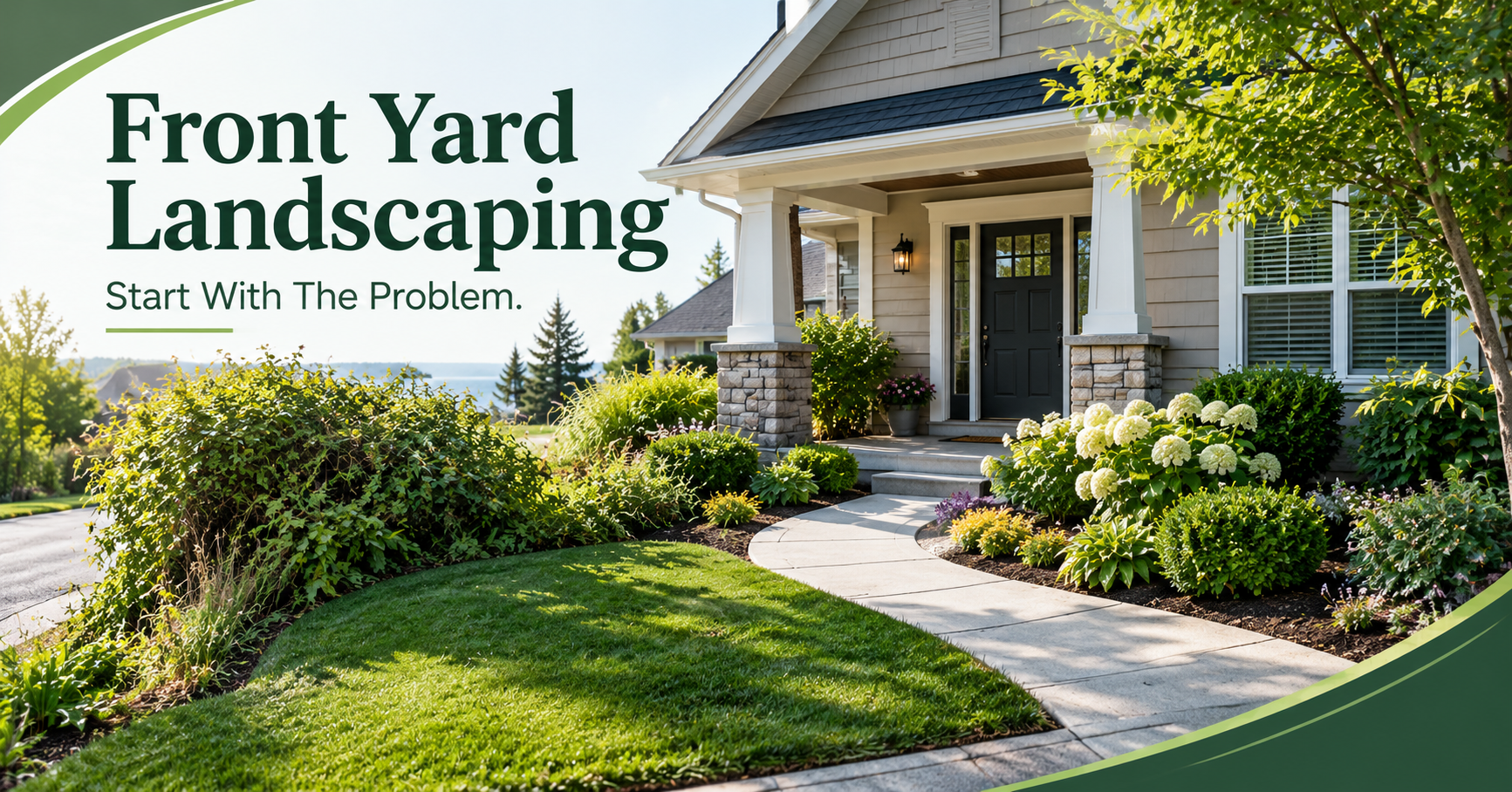
Most front yard landscaping ideas you’ll find online start with a plant list. That’s backward. The plants that fix an overgrown entrance are not the plants that fix a bare, sun-baked strip along the driveway. Before you pick anything, you need to know which problem you’re actually solving, and that depends on how your property looks and functions right now, not on a Pinterest board.
Key Takeaways
- The right front yard plan starts with naming the actual problem, clutter, overgrowth, no layout, or too much upkeep, not with a plant list.
- A front yard doesn’t need to be filled to look finished; it needs a clear layout that frames the entrance and walkway.
- Overgrown foundation plantings are one of the most common front-yard issues, and they’re usually fixed by removing or relocating one or two oversized plants, not by tearing out the whole bed.
- Curb appeal carries real weight with buyers and appraisers alike, but even if you’re not selling, the same principles make a yard easier to enjoy and maintain.
At a Glance
- Usual answer: Match your plan to the specific problem your front yard has, cluttered, overgrown, undefined, or high-maintenance, rather than starting from a generic style.
- Main exception: A front yard with a structural issue, such as drainage or grading, needs that addressed before any planting plan will hold up.
- Biggest mistake: Adding new plants on top of an unsolved layout problem instead of fixing the layout first.
- When professional help matters: Grading, drainage, foundation plantings around windows or utilities, and anything requiring equipment.
- Relevant service: Front yard landscaping and planting design
What Problem Does Your Front Yard Actually Have?
Front yards tend to fall into a handful of recognizable situations. Reviewing outdoor properties, Ashley’s landscaping page notes the same patterns show up again and again: a yard that lacks a clear layout, plantings that have outgrown their spot, an entry that needs more structure, or maintenance that’s become harder than it should be.
| Your front yard’s problem | What usually helps | What to watch for |
| No clear layout, lawn and scattered plants with no shape | Define beds along the walkway and foundation to create structure | Don’t just add more plants; add edges and shape first |
| Overgrown shrubs blocking windows or the walkway | Remove or relocate the one or two oversized plants doing the most damage | Shearing everything smaller looks worse than selective removal |
| Bare or patchy beds with little seasonal interest | A mixed planting of perennials and a few evergreens for year-round structure | Full sun versus shade changes which plants will actually survive |
| Entrance is hard to identify from the street | Open sightlines to the door and add simple framing plants at the entry | Don’t crowd the porch trying to “soften” it |
| Yard looks fine but takes constant upkeep | Simplify plant variety and reduce high-maintenance features | Removing everything trades one problem for a boring yard |
| Downspout or low spot keeps soil soggy | Plant species that tolerate wet soil in that specific spot | Standard perennials will struggle or rot there |
Why This Happens in the First Place
Most problem front yards weren’t planned badly on purpose. They’re often the result of small decisions made over years, a shrub planted too close to the foundation because it looked small at the time, a bed added without a plan for what comes next to it, or maintenance that got skipped for a season and never quite caught back up.
Plantings that seemed proportional five years ago often aren’t proportional now. A foundation shrub doubles or triples in size, a hedge presses into the driveway, and nobody adjusts the layout to match, because nothing forced the issue until the window is half-blocked or the walkway has narrowed. Recognizing this is less about blame and more about knowing where to start: usually with what has changed, not with what to add.
A Simple Way to Approach Any Front Yard Plan
Instead of jumping straight to plant choices, run the yard through three questions. This works for almost any front yard problem:
Assess. What does the sun, shade, drainage, and slope actually look like in this spot, not what you assumed when the house was built.
Anchor. Does the entrance read clearly from the street? Can you see the door, the walkway, and the main windows without anything blocking them?
Adjust. Is the maintenance load realistic for how much time you actually want to spend, or does the plan need fewer, hardier plants instead of more variety?
A plan that answers all three tends to hold up. A plan that skips straight to plant selection usually needs to be redone within a few seasons.
Practical Steps for Planning Your Front Yard
- Walk the yard from the street, not just from inside the house. What a visitor sees first is what the plan needs to solve first.
- Identify what’s blocking the entrance or walkway, a shrub, branch, or hedge, before adding anything new.
- Note the actual sun and soil conditions in each section, since front yards often have very different light between the foundation, curb, and corners.
- Decide what stays. A mature tree or an established bed with good structure is usually worth keeping and building around, not removing.
- Group the work by area, entrance, foundation, curb strip, instead of tackling the whole yard as one undefined project.
- Confirm the scope with a professional if the plan involves grading, drainage, or removing anything near utilities or the foundation.
Common Mistakes in Front Yard Landscaping
Filling every open space. A front yard doesn’t need to be packed to look finished. Open, well-edged lawn next to a defined bed often looks more intentional than a yard with no negative space left.
- Do this: Leave breathing room around key plants and let the layout, not plant volume, do the work.
- Not that: Adding more plants to “finish” a yard that actually just needs edges and shape.
Ignoring what’s blocking the entrance. New plants at the mailbox won’t fix a yard where the front door is hidden behind an overgrown hedge.
- Do this: Solve sightline problems to the entrance first.
- Not that: Adding a new feature somewhere else in the yard while the real issue stays untouched.
Choosing plants for looks alone. A plant that needs full sun will struggle in a shaded foundation bed no matter how good it looks in the photo.
- Do this: Match plant choice to the sun, soil, and drainage actually present in that spot.
- Not that: Picking plants first and hoping the site will accommodate them.
DIY or Professional Help?
DIY front yard work can be reasonable when the project is small and doesn’t touch drainage, grading, or anything structural.
DIY may be reasonable when:
- The area is a small bed or curb strip
- You’re adding or swapping plants without changing the layout
- No slope, drainage, or foundation issue is involved
- You have the tools and time for ongoing care afterward
Professional help is usually the safer call when:
- The front yard needs regrading or drainage correction
- Overgrown plantings are close to the foundation, windows, or utility lines
- The project connects to a walkway, patio, or retaining wall
- You want the layout planned once instead of adjusted repeatedly
If you’re not sure which category your project falls into, that’s a normal reason to ask before starting, not a sign you’re overthinking it.
A Realistic Example
Picture a front yard where two overgrown evergreen shrubs sit directly under the living room windows. They were planted small fifteen years ago. Today, they block half the glass, crowd the walkway, and make the porch feel darker than it should. The homeowner doesn’t want to lose all the greenery, just fix the imbalance.
In a case like this, the fix usually isn’t removing everything. It’s removing or relocating the one or two plants causing the actual problem, then filling the space with something proportional to the window and walkway. This is an illustrative scenario, not a specific past project, but it reflects the kind of layout issue Ashley’s landscaping page already flags as one of the most common front yard concerns.
Front Yard Landscaping in Door County and Ellison Bay
A few local conditions change how front yard plans hold up here specifically:
- Freeze-thaw cycles can heave shallow-planted material and shift soil near walkways, which is worth checking before finalizing bed edges.
- Seasonal occupancy is common in Door County. A plan that needs constant attention doesn’t fit a property that sits empty for stretches of the year.
- Snow storage matters near the driveway and walkway. Plants placed too close to areas where plowed snow piles up can be damaged season after season, which connects directly to snow plowing planning for the property.
- Short growing season means plant establishment timing matters more here than in warmer regions. Starting too late can limit how well new plantings settle in before winter.
Final Thoughts
A front yard doesn’t need a complete overhaul to look and function better. Most of the time, it needs one clear problem identified and solved: an overgrown shrub moved, a layout defined, an entrance opened back up. Start there before adding anything new.
If you’re standing in your front yard trying to figure out where to start, the property itself usually has the answer. What’s blocking the entrance? What’s outgrown its spot? What takes more upkeep than it should? Those questions point to the plan that actually fits.
The right front yard landscaping plan depends on the specific problem your property has, not a general style. Ashley’s Property Maintenance can review the property, talk through what you want to change, and outline a scope that fits both the yard and how much upkeep you actually want going forward.
Frequently Asked Questions
What’s the best front yard landscaping idea for a small yard?
Definition and restraint usually work better than variety. A small yard benefits from one or two well-placed beds with a clear edge, rather than several small plantings scattered around. Keeping sightlines to the entrance open also makes a small front yard feel larger than it is.
How do I know what front yard landscaping plan fits my house?
Start with the problem, not the style. If the entrance is hidden, the fix is different than if the yard just looks bare. Matching the plan to the actual condition of the property, not a general style preference, is what makes it hold up over time.
Is it better to remove an overgrown shrub or trim it?
It depends on the shrub’s growth habit and how much it’s already outgrown its spot. Some shrubs respond well to selective pruning; others will simply return to the same size within a season or two. A site visit is usually the fastest way to know which applies.
Does front yard landscaping actually increase home value?
Realtors surveyed for a national outdoor-features study reported that curb appeal plays a significant role in attracting buyers, and most recommended sellers improve it before listing. That said, value impact depends on the specific project, the market, and the property. It isn’t guaranteed for every yard or every improvement.
When is the best time to start a front yard landscaping project in Door County?
Timing depends on the scope of work and current site conditions. Because the growing season here is shorter than in warmer regions, earlier planning generally gives new plantings more time to establish before winter.
Can I landscape my front yard myself, or should I hire someone?
Small, non-structural updates, like refreshing an existing bed, are often reasonable to do yourself. Projects involving drainage, grading, or plantings near the foundation are usually safer with professional input.
What’s the most common mistake in front yard landscaping?
Adding new plants before fixing an existing layout problem. If the entrance is hidden or the beds have no defined edge, new plantings tend to make the issue more visible rather than solving it.
How much does front yard landscaping cost?
Cost depends on the size of the project, existing site conditions, and how much preparation or plant material is involved. Ashley’s needs enough information about the property and goals to provide an accurate scope before estimating.
How do I get a front yard landscaping estimate from Ashley’s?
Reach out through Ashley’s contact page with your address, what you’d like to change, and any features you want to keep. Ashley’s will review the property and outline the appropriate next step.