The cheapest snow plowing option cannot be identified from the quoted price alone.
A per-push rate may look inexpensive until a busy winter brings repeated service visits. A seasonal contract may look expensive before the first storm, then become easier to justify when snow keeps returning.
That is the real issue behind the snow plowing contract vs per push decision.
You are not simply comparing two prices. You are deciding who carries more of the financial uncertainty created by winter weather.
For Door County homeowners, that distinction deserves attention. The Wisconsin State Climatology Office currently reports an annual snowfall average of 58.7 inches for Door County using 1996 through 2025 data. That figure does not predict what any one winter will bring, but it shows why snow service is a recurring property-access concern rather than an occasional afterthought.
Ashley’s Property Maintenance LLC provides snow removal services in Ellison Bay and the confirmed Door County service area for approved residential and commercial areas. Its website does not currently publish one standard per-push or seasonal pricing structure, so homeowners should confirm which service arrangement is available for their property before comparing costs.
Key Takeaways
- Per push means your bill changes with the number of billable service visits. Fewer visits can mean lower seasonal spending, while a busy winter can increase the total.
- Seasonal pricing trades weather uncertainty for budget predictability. The important question is exactly which visits and services are included.
- The break-even point matters more than either headline price. Divide the seasonal quote by the comparable per-push charge to see how many pushes would make the totals equal.
- Contract wording can change the comparison completely. Trigger depth, repeat visits, walkways, snow placement, large-storm rules, and additional services can affect what you actually pay.
What Is the Difference Between Per-Push and Seasonal Snow Plowing?
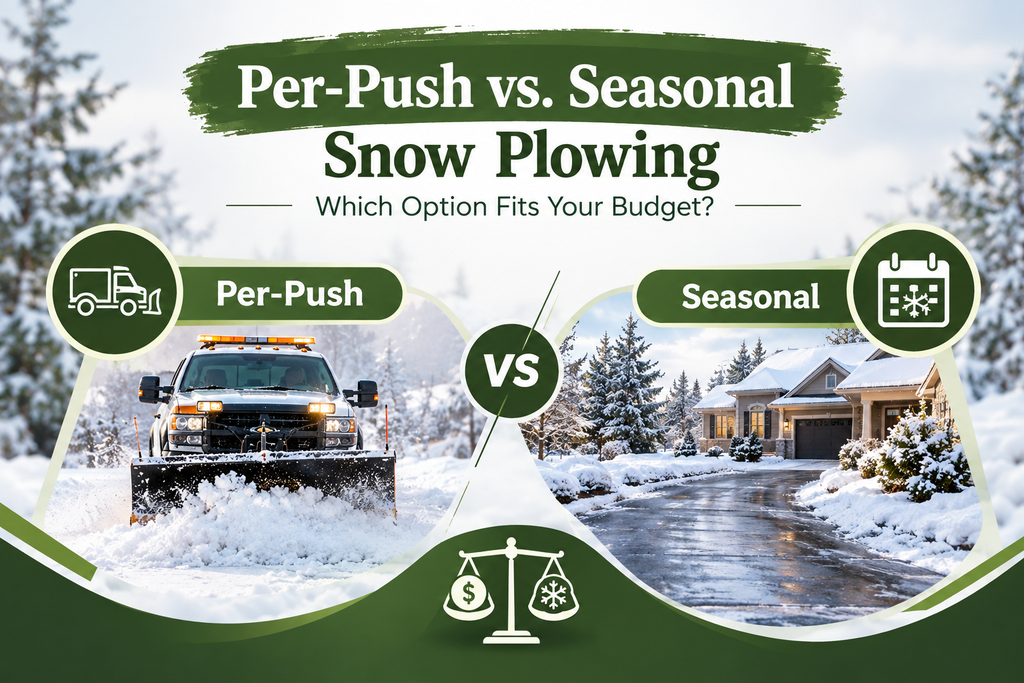
Per-push snow plowing charges you when a qualifying service visit occurs. A seasonal snow plowing agreement sets an agreed price for the defined winter service period. Per push gives the homeowner more weather-related cost variability, while a seasonal agreement can make budgeting more predictable.
The definitions sound simple. The contract details are not.
Per-Push Snow Plowing
Under a per-push arrangement, you pay a stated amount each time the contractor performs an eligible clearing visit.
That does not always mean one bill per snowstorm.
A long storm may require more than one clearing. Some contractors charge each visit separately. Others use per-event or snowfall-depth pricing.
That distinction must be clear before service begins.
If your agreement says “per push,” ask what legally and operationally counts as one push.
Seasonal Snow Plowing
A seasonal agreement sets a price for snow service across an agreed winter period.
Payment might be made at once or according to an agreed billing schedule. What matters is that the service is priced around the season instead of billing every individual visit in the same way as per-push service.
But “seasonal” does not automatically mean unlimited everything.
The agreement might define:
- A trigger depth
- Covered clearing areas
- Service timing
- Storm limits
- Snow-placement locations
- Additional charges
- Excluded services
- Rules for unusually large events
Two seasonal quotes can therefore describe very different levels of service.
Which Option Actually Costs Less?
Here is the cleanest answer:
Per push costs less when your total number of billable visits multiplied by the per-push charge remains below the seasonal price, assuming the services being compared are equivalent. Seasonal pricing costs less when equivalent per-push charges would exceed the seasonal total.
The comparison becomes much easier when you calculate the break-even point.
Use This Break-Even Formula
Seasonal contract price ÷ comparable per-push price = break-even number of pushes
Do not stop there.
The two quotes need to cover approximately the same work before the result means anything.
If the seasonal agreement includes driveway and walkway clearing while the per-push quote covers only the driveway, dividing one price by the other creates a misleading answer.
The same applies if one quote includes repeat visits during a long storm and the other charges separately.
Build a True Cost Comparison
| Question | Per Push | Seasonal |
| Base pricing | Charge per eligible visit | Agreed seasonal amount |
| Mild winter | Potentially fewer charges | Seasonal amount generally remains due under agreed terms |
| Busy winter | More billable visits may raise total | Greater budget predictability if events remain within contract terms |
| Budget certainty | Lower | Higher |
| Weather-cost risk for homeowner | Higher | Lower |
| Need to study visit definition | Very important | Important |
| Need to study exclusions | Very important | Very important |
| Best comparison method | Estimate total billable visits | Compare full seasonal scope |
Why Door County Weather Changes the Math
The mistake is trying to predict next winter perfectly.
You cannot.
Climate history helps establish context, but an average does not tell you how many times your particular driveway will require service.
Ten inches arriving in one storm does not necessarily create the same billing pattern as ten inches arriving across several separate events.
Wind can also affect drifting.
A long-duration snowfall can create another question: will the contractor clear once after the storm or make an earlier pass to keep access usable?
That is why snowfall totals alone cannot tell you which contract will save more.
The number of billable service events matters more to the per-push calculation.
The Weather-Risk Rule Makes the Choice Easier
Think about each contract as a way of assigning winter uncertainty.
With Per Push, the Homeowner Carries More of the Cost Variability
If relatively few qualifying visits occur, you may spend less.
If the contractor needs to visit repeatedly, your seasonal total grows.
That can work well for homeowners who are comfortable with a winter bill that moves with actual service.
With Seasonal Pricing, the Contractor Takes More Weather Exposure
You agree to the seasonal price defined in the contract.
A quieter winter may mean you pay more than you would have under a low number of per-push visits.
A busier winter may make the seasonal arrangement financially attractive, provided those additional visits remain included under the agreement.
This does not make seasonal pricing automatically better.
You are paying partly for predictability.
What Should Door County Homeowners Compare Besides Price?
The lowest quote can become the more expensive choice when two contractors are not quoting the same service.
Compare the scope line by line.
1. Trigger Depth
The trigger is the amount of accumulation that causes service to begin under the agreement.
Do not assume every contractor uses the same trigger.
A lower trigger may generate more per-push visits than a higher trigger.
That makes trigger depth part of the price calculation, not merely an operational detail.
2. Multiple Visits During One Storm
Ask this exact question:
If snow continues for many hours and the property is cleared twice, is that one charge or two?
You need the answer in writing.
A per-push quote can look attractive until the homeowner discovers that a prolonged storm creates several billable visits.
3. Driveway, Sidewalk and Walkway Coverage
Ashley’s advertises driveway, sidewalk, and walkway clearing, but its site also states that the exact approved areas should be defined before service begins.
Do not assume every quote covers every surface.
A driveway-only price should not be compared directly with a package covering several access routes.
4. Snow Placement
Snow has to go somewhere.
As winter continues, earlier piles can reduce available space for later plowing.
Ashley’s specifically recommends discussing snow-placement areas before service begins because driveway layout, entrances, walkways, landscaping, and available space can affect the clearing plan.
If your property has limited stacking room, ask what happens when those areas fill.
5. Additional Winter Services
Do not automatically assume plowing includes salting, sanding, deicing, snow hauling, roof clearing, or other winter work.
Ashley’s current snow-removal page says salting, deicing, hauling, and other unconfirmed tasks should not be assumed as standard inclusions.
Compare like with like.
Per Push May Make More Sense When…
Per-push pricing can fit homeowners who want their cost closely tied to the snow services actually performed.
It may deserve stronger consideration when you:
- Are comfortable with changing winter costs
- Prefer paying for qualifying visits instead of a season-wide commitment
- Do not need a highly fixed winter-maintenance budget
- Have a property with straightforward clearing needs
- Understand exactly when repeat visits create another charge
That still does not mean per push will definitely cost less.
Its financial advantage depends on what actually happens during the winter.
A Seasonal Contract May Make More Sense When…
Seasonal pricing can fit homeowners who care more about predictable winter budgeting.
It may be worth considering when you:
- Want one known seasonal service cost
- Need recurring driveway access throughout winter
- Do not want each storm to create another budgeting decision
- Own a property where dependable ongoing service matters
- Understand the seasonal agreement’s limits and exclusions
Door County also includes seasonal properties, and Ashley’s identifies seasonal properties as part of the types of outdoor properties it supports.
For a homeowner who is away for part of winter, the decision may involve more than price. Ask how service occurs when nobody is there, whether parked vehicles affect clearing, and how the property will be handled during repeated storms.
What If You Own a Seasonal or Second Home?
This is one place where many generic snow-contract articles miss the homeowner’s real problem.
You may not be standing at the property after every snowfall.
That changes the questions worth asking.
You may care about:
- Whether the driveway remains accessible for planned visits
- Access for property checks or service providers
- Where snow accumulates while you are away
- Whether vehicles need to be moved
- How you will know service occurred
- What happens after consecutive storms
- Whether a service request must be made manually
A low per-push rate is not especially helpful if the service arrangement does not fit how you actually use the property.
The schedule matters.
What Most Homeowners Get Wrong
Mistake 1: Comparing Only the Two Headline Prices
A seasonal number and a per-push number do not tell the whole story.
Do this: Compare included surfaces, triggers, repeat visits, storm rules, and extras.
Not that: Pick the smaller number without comparing scope.
Mistake 2: Treating “Per Push” and “Per Storm” as the Same Thing
They may not be.
One storm can require more than one visit.
Read the billing definition.
Mistake 3: Assuming Seasonal Means Unlimited Service
The contract controls.
A seasonal agreement may have defined limits, exclusions, service windows, or other conditions.
Mistake 4: Forgetting About Snow Storage
A driveway can become narrower over the course of winter if snow is repeatedly placed in the same limited areas.
Plan those locations before the first significant snowfall.
Ashley’s existing year-round landscape maintenance checklist also recommends identifying snow-storage locations before winter and keeping piled snow from interfering with drainage.
Mistake 5: Relying on a Conversation Instead of the Written Agreement
The Wisconsin Department of Agriculture, Trade and Consumer Protection gives consumers direct advice:
“Do not rely on oral agreements.”
Its guidance recommends reading contracts carefully and getting the agreed work clearly documented.
Read Wisconsin DATCP’s current consumer contract guidance
Use the PLOW Test Before Choosing a Contract
Here is a simple framework you can use when comparing quotes.
P: Price Structure
Identify exactly how billing works.
Is it per visit, per event, by accumulation, or a fixed seasonal amount?
L: Limits
Find every limit in the agreement.
Look for trigger depths, seasonal caps, additional-charge conditions, and excluded work.
O: Operations
Understand how the service actually happens.
Ask about service timing, repeat visits, vehicle access, sidewalks, and snow-placement areas.
W: Winter Cost
Calculate your break-even point and decide which type of uncertainty you would rather carry.
This final step is where “cheapest” becomes personal.
One homeowner may prefer the possibility of spending less during a quiet winter.
Another may willingly pay a known seasonal amount to avoid variable invoices.
A Practical Homeowner Scenario
Imagine two homeowners receive both a per-push quote and a seasonal quote for comparable driveway clearing.
The first homeowner mainly cares about spending as little as possible if the winter requires relatively few visits. A changing monthly total does not create a budgeting problem.
Per push may match that preference.
The second homeowner wants the snow budget established before winter begins. The property must remain accessible throughout the season, and surprise service totals would be inconvenient.
Seasonal pricing may fit that priority better.
Neither homeowner can know the winter in advance.
The right comparison is not based only on who guesses the weather correctly.
It is based on cost tolerance, property needs, and the written terms.
Five Steps to Compare Your Snow Plowing Quotes
Step 1: Make Both Contractors Quote the Same Areas
List the driveway, parking area, sidewalk, walkway, and entrance areas that require attention.
Do not compare mismatched scopes.
Step 2: Write Down the Trigger
Record when each contractor begins service.
The trigger can change how often per-push billing occurs.
Step 3: Ask How a Long Storm Is Billed
Find out whether repeat clearing creates additional charges.
Do not leave this until the first long-duration storm.
Step 4: Calculate the Break-Even Visit Count
Divide the seasonal total by the comparable per-push price.
Then treat that number as a decision aid, not a snowfall forecast.
Step 5: Read Every Exclusion
Check snow hauling, sidewalks, deicing, unusual accumulation, access restrictions, vehicle interference, and other services that matter to your property.
How Does Ashley’s Property Maintenance Fit Into the Decision?
Ashley’s Property Maintenance LLC provides local outdoor property care from Ellison Bay for residential and commercial properties in the Door County area. Its current services include landscaping, lawn care, seasonal maintenance, stump grinding, patios, pressure washing, and snow plowing.
For winter work, Ashley’s asks customers to explain the property location, approved areas, access conditions, and snow-placement needs before the service arrangement is defined.
That matters for this comparison.
Ashley’s website currently does not state that every customer can choose between a published per-push plan and a published fixed seasonal plan.
So the next step should not be assuming a pricing model.
It should be asking what arrangement is currently available for your address and comparing that offer against your actual winter-access needs.
You can review Ashley’s broader property maintenance services in Ellison Bay when planning other seasonal work around the property.
For additional winter property context, see Ashley’s guide to the benefits of snow removal for property access and safety.
Final Thoughts
There is no universal winner in the snow plowing contract vs per push comparison.
Per push can cost less when relatively few billable visits occur and the services included are otherwise comparable.
A seasonal agreement can become financially attractive when the per-push total would cross its break-even point. Its other advantage is simpler budget planning.
But the contract structure alone does not tell you what you are buying.
Trigger depth, repeated visits, sidewalks, snow placement, service windows, storm limits, and extra winter services can move the real cost far more than homeowners expect.
Start with the property rather than the pricing label.
Define what needs to stay accessible, compare identical scopes, calculate the break-even point, and read the service terms before deciding.
If you need winter access maintained in Ellison Bay or the confirmed Door County service area, review Ashley’s residential snow plowing service and request an estimate based on the areas your property actually needs cleared.
Need a Snow Plowing Estimate for Your Door County Property?

If you want help keeping an approved driveway, sidewalk, or walkway accessible during winter, Ashley’s Property Maintenance LLC can review your property, clearing priorities, access conditions, and available snow-placement areas.
Contact Ashley’s at 920-412-8204 and ask which snow-service arrangement is currently available for your property before comparing the winter cost.
Frequently Asked Questions
Is per-push or seasonal snow plowing cheaper?
Neither option is always cheaper. Per push costs less when the total cost of qualifying visits remains below the comparable seasonal price. Seasonal pricing can cost less when the accumulated per-push charges exceed that amount. The included work must be similar before comparing the totals.
How do I calculate whether a seasonal snow contract is worth it?
Divide the seasonal price by the comparable per-push price. The result gives you a break-even number of service visits. Then review trigger depth, repeat-visit rules, included areas, and extras because those details affect whether the two quotes are truly comparable.
What does per push mean in snow removal?
Per push usually means the contractor charges for each qualifying clearing visit. The exact definition can vary by agreement. One prolonged snow event may involve more than one visit, so ask whether each visit creates another charge before accepting a per-push proposal.
Is per push the same as per storm?
Not necessarily. Per-push billing commonly relates to each clearing visit, while per-event pricing can treat the storm as the billing unit. Contractors may use terms differently, which is why the written definition in your service agreement matters more than the label.
What should a snow plowing agreement explain?
It should clearly describe the property, areas being cleared, pricing method, trigger conditions, service expectations, snow-placement areas, exclusions, and any conditions that create additional charges. Wisconsin consumer guidance also recommends understanding a contract fully before signing it.
Can one snowstorm result in multiple per-push charges?
Yes, depending on the agreement. A long storm may require repeated clearing to maintain access. If each visit is considered a separate push, more than one charge may occur. Ask how continuing snowfall and repeat service are billed before winter starts.
Does Ashley’s offer seasonal snow contracts in Door County?
Ashley’s website currently confirms snow removal for qualifying residential and commercial properties but does not publish a standard seasonal-contract pricing program. Ask Ashley’s directly which service arrangement is currently available for your property rather than assuming a specific billing model.
Does Ashley’s offer per-push snow plowing?
Ashley’s website currently describes snow plowing and the need to define scheduling arrangements but does not publicly confirm a universal per-push pricing program. Property owners should request the current pricing and service terms for their address.
Are sidewalks and walkways automatically included with driveway plowing?
Do not assume they are. Ashley’s advertises clearing for approved driveways, sidewalks, and walkways, but the exact service area should be defined before work begins. A quote should identify which surfaces are included so you can compare competing offers fairly.
When should I arrange snow plowing in Door County?
It is better to discuss winter service before dependable access becomes an immediate problem. Ashley’s notes that availability can depend on the property, requested clearing areas, service arrangement, and current seasonal schedule.