Wisconsin winter can make a fresh landscape bed look very different by spring.
Months of snow, frozen ground, thaw periods, wind, runoff, and temperature swings test more than the color of your mulch. They test whether the material stays where it belongs, continues covering the soil, protects the root zone, and leaves the bed manageable when the snow disappears.
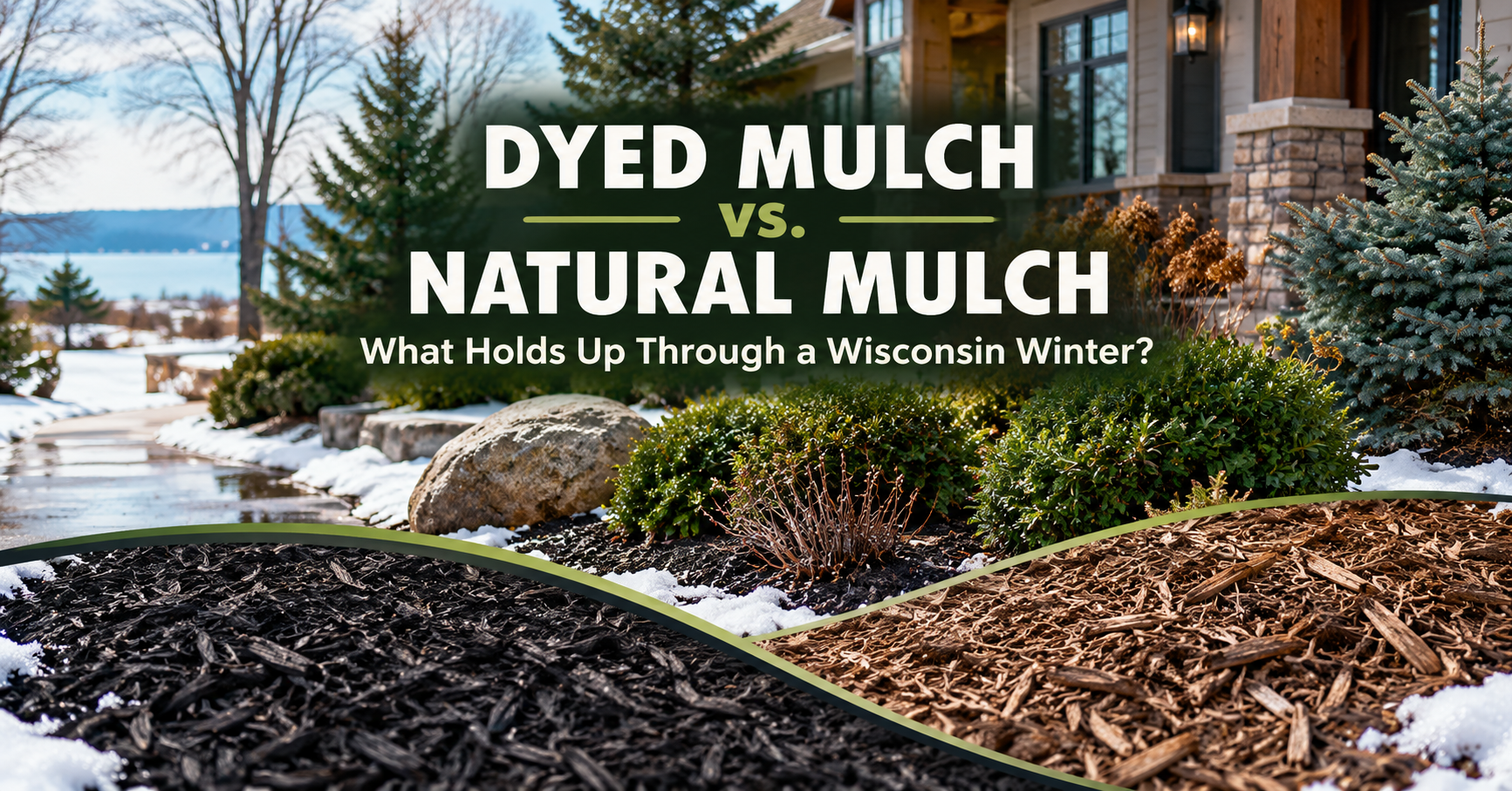
That makes the dyed mulch vs natural mulch winter decision more complicated than choosing black, brown, or natural wood at the landscape yard.
For homeowners around Ellison Bay and Door County, the better question is this: Which mulch fits the bed, the plants, and what you want that bed to look like after winter?
Ashley’s Property Maintenance LLC works with landscape beds as part of year-round outdoor property care, so winter performance should be considered before mulch goes down, not only after spring cleanup begins.
Key Takeaways
- The dye itself does not determine winter protection. Material, depth, particle structure, and placement matter more.
- Dyed mulch usually has the visual advantage when consistent color is the main goal.
- Natural wood mulch makes sense when soil improvement and a more natural appearance matter more than lasting color.
- Wood source matters with dyed products. Ask what the mulch is made from, especially when recycled wood is used.
- For Wisconsin winters, the real job of mulch is temperature moderation, particularly reducing damaging freeze-thaw swings around roots and plant crowns.
Does Dyed Mulch or Natural Mulch Protect Plants Better in a Wisconsin Winter?
For winter protection alone, neither dyed nor natural wood mulch automatically wins. Both can help moderate soil-temperature changes when the material is suitable, spread correctly, and kept at a healthy depth. The color on the wood matters far less than the mulch layer itself.
That distinction matters in Wisconsin.
UW–Madison Division of Extension explains that winter mulch is generally used “not to prevent the ground from freezing, but rather to avoid freezing and thawing cycles over the course of winter.”
That is the core winter issue.
Repeated thawing and refreezing near the soil surface can contribute to heaving around shallow-rooted plants and expose vulnerable crowns or roots. A stable mulch layer acts as insulation between the soil and rapid air-temperature changes.
Snow adds insulation too, but snow cover is not constant enough to treat it as the only winter protection.
Current NOAA 1991–2020 climate normals list 57.4 inches of mean annual snowfall at the Sturgeon Bay Experimental Farm station. That number shows how snow-heavy the regional climate can be, but a seasonal snowfall total does not mean the ground remains covered by one uninterrupted insulating layer all winter.
Dyed Mulch vs Natural Mulch: What Is the Real Difference?
Both options can be wood-based organic mulch. The main differences involve the wood source, appearance, weathering, and what happens as the material ages.
| Factor | Dyed Mulch | Natural Mulch |
| Winter soil coverage | Can work well when applied correctly | Can work well when applied correctly |
| Color after weather exposure | Usually stays more uniform | Naturally fades and weathers |
| Soil contribution | Depends on wood source and decomposition | Gradually contributes organic material as it breaks down |
| Wood source | May include clean recycled wood or other processed wood | Often bark, shredded hardwood, wood chips, or similar untreated material |
| Main visual advantage | Strong, consistent color | Softer, natural appearance |
| Main buying question | What wood was used beneath the color? | What wood type and particle size fit the bed? |
| Best fit | Decorative, high-visibility beds | Beds where natural appearance and soil-building matter |
What Is Dyed Mulch?
Dyed mulch usually consists of shredded wood treated with a colorant to create black, brown, red, or another consistent shade.
The color itself deserves less concern than many homeowners assume.
UMass Amherst notes that common mulch colorants include iron oxide and carbon-based materials and states that there is currently no evidence that the dyes normally used to color wood-chip mulch are toxic. The university instead points to the source of recycled wood as the issue worth checking because contaminated construction and demolition wood can contain unwanted materials such as CCA-treated lumber.
So the useful question at the supplier is not simply:
“Is this mulch dyed?”
Ask:
“What is the wood source, and how is treated or contaminated wood kept out of the product?”
That tells you much more.
What Is Natural Mulch?
Natural mulch skips the added decorative color.
Depending on the product, it may contain shredded hardwood, bark, wood chips, cedar, pine, or another plant-based material.
Its appearance changes as sunlight, moisture, and normal decomposition weather the surface. That fading does not automatically mean the mulch has stopped doing its job.
Natural mulch also breaks down gradually and returns organic material to the soil surface. How quickly that happens depends on wood species, particle size, moisture, microbial activity, and the condition of the bed.
For homeowners who prefer a landscape that ages naturally instead of maintaining a uniform black, brown, or red finish, that can be a benefit rather than a drawback.
Which Mulch Actually Holds Up Better Under Snow, Wind, and Thawing?
The answer depends more on structure than color.
Very fine material can shift, mat, or move with runoff. Larger loose chips may also migrate when beds sit on slopes or receive strong wind.
Shredded wood has an advantage in many landscape beds because the irregular fibers can settle together rather than behaving like separate smooth pieces.
That does not mean the coarsest product is automatically best. Bed slope, drainage, existing mulch, edging, plant spacing, and snow-removal activity all affect how well a mulch layer stays in place.
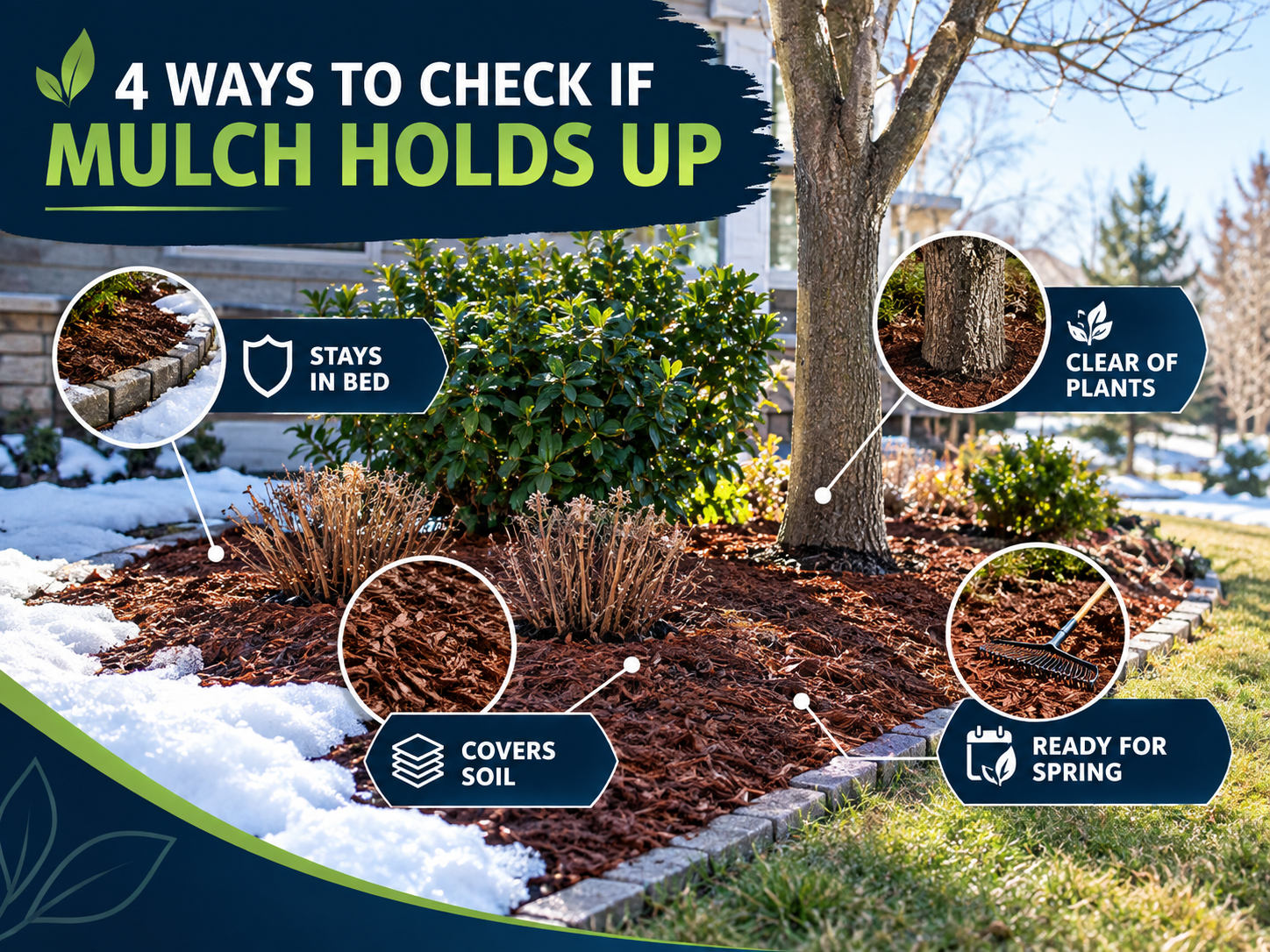
Think About “Holding Up” in Four Different Ways
A mulch that survives winter well should do four things:
1. Stay in the Bed
Look for material that fits the slope, drainage pattern, bed edge, and exposure.
2. Keep Reasonable Soil Coverage
Bare patches reduce the benefit of having mulch in the first place.
3. Avoid Burying Plants
Winter protection does not require piling wood against trunks, shrub stems, or perennial crowns.
4. Remain Manageable in Spring
A mulch bed that survives winter but turns into a deep, compacted layer still needs correction.
Ashley’s existing guide on whether old mulch should be removed before adding new mulch explains why spring decisions should begin with the condition and depth of the material already in the bed.
Does Dyed Mulch Keep Its Color Better Through Winter?
Usually, appearance is where dyed mulch has its clearest advantage.
The purpose of the added colorant is to create a more uniform finish and reduce how quickly the bed appears faded.
Natural mulch changes color more visibly as wood weathers. That may produce gray, tan, or lighter brown areas long before the material has finished serving as mulch.
Wisconsin winter adds another complication.
By spring, a landscape bed may have dealt with:
- Snow sitting on the mulch
- Repeated wetting and drying
- Ice
- Wind
- Fall leaves
- Snowmelt
- Soil splash
- Material pushed by shoveling or plowing
- Debris trapped in the bed
For that reason, color retention and physical performance should be judged separately.
A dyed bed may still look darker in April but require raking or redistribution.
A natural bed may look faded but still have good coverage and usable mulch underneath.
Do not replace a functional mulch layer simply because its surface color has changed.
Does Natural Mulch Perform Better for Soil?
Natural organic mulch has a straightforward long-term advantage: as plant-based material decomposes, it becomes part of the organic material at the soil surface.
That process happens gradually.
Mulch should still remain primarily on top of the soil instead of being aggressively tilled into the root zone. Large amounts of fresh wood mixed into soil behave differently from wood resting on the surface.
This distinction is especially useful when maintaining established shrubs, trees, and perennial beds.
If your priority is:
- Building a more natural soil surface
- Allowing mulch to age into the landscape
- Avoiding concerns about recycled wood source
- Using a less visually processed material
Natural mulch often makes more sense.
If your priority is:
- Strong color contrast
- A consistent decorative finish
- Matching mulch to siding, stone, or other landscape features
A responsibly sourced dyed product may suit the property better.
Is Dyed Mulch Safe Around Plants?
The colorant itself is not the main concern with reputable products.
UMass Amherst’s current fact sheet says iron oxide and carbon-based colorants are commonly used and reports no evidence that normal wood-chip mulch dyes are toxic. Its warning focuses instead on contaminated recycled wood, particularly construction and demolition material containing treated lumber.
That leads to a simple buying rule:
Do this: Ask where the wood came from.
Not that: Judge safety from the mulch color alone.
A known supplier that can explain its feedstock gives you better information than an unlabeled pile with no clear source.
The 4S Winter Mulch Check
Before deciding between dyed and natural mulch, use this four-part test.
Source
Know what the product is made from.
With dyed mulch, ask specifically about recycled wood and whether treated construction lumber is excluded.
Structure
Look at the actual mulch, not only a color sample.
Consider whether the particles fit your bed slope, edging, drainage, and exposure.
Space
Check the mulch already present.
Keep material away from trunks, major stems, and plant crowns rather than building mounds around them.
Spring Goal
Decide what matters most when winter ends.
Do you want strong color immediately after snowmelt?
Do you prefer a material that weathers naturally?
Are you trying to improve the bed over several seasons?
Answering those questions makes the color decision much easier.
When Should You Prepare Mulched Beds for a Wisconsin Winter?
Winter preparation should start with the plants and soil, not the mulch bag.
UW–Madison’s 2025 winter landscape guidance recommends checking soil moisture before the ground freezes and explains that many winter mulches are applied after plants become dormant and soils begin to freeze. For tender perennials and similar plantings, the Extension specifically discusses materials such as straw, marsh hay, and evergreen boughs.
Read UW–Madison’s current winter landscape guidance
This creates an important distinction homeowners often miss:
Decorative landscape mulch and protective winter mulch are not always the same thing.
Shredded hardwood may remain around established shrubs and trees year-round.
A tender perennial that needs extra crown protection may call for a different winter treatment.
Matching the material to the plant matters more than simply adding another thick layer before the first snow.
Five Steps to Prepare Existing Mulch Before Winter
1. Inspect the Current Layer
Move mulch aside in several areas.
Check for deep spots, bare spots, matting, debris, weeds, and material pushed against plants.
2. Correct the Depth Before Adding More
Do not assume every bed needs another full layer.
Several years of top-dressing can leave more mulch underneath than the surface appearance suggests.
3. Pull Mulch Away From Trunks and Crowns
Create visible space around tree trunks, shrub stems, and sensitive plant crowns.
Do not build mulch volcanoes.
4. Check Drainage and Low Areas
Watch where fall rain collects.
A mulch refresh will not repair a drainage problem.
5. Decide Whether You Need Function, Color, or Both
Some beds need additional material.
Others need only raking and redistribution.
A front entrance may justify a fresh decorative finish while a less visible planting bed may not.
For a broader seasonal routine, use Ashley’s Wisconsin landscape maintenance checklist to connect mulch care with fall cleanup, drainage checks, snow preparation, and spring inspection.
What Most People Get Wrong About Winter Mulch
Mistake 1: Assuming Darker Mulch Gives Better Winter Protection
Black mulch looks different from natural wood, but darker color does not automatically make it the better winter insulator.
Layer condition and placement matter more.
Mistake 2: Adding Mulch Every Fall Without Measuring What Is Already There
The top can look faded while several inches remain underneath.
Adding more based only on color can create excessive buildup.
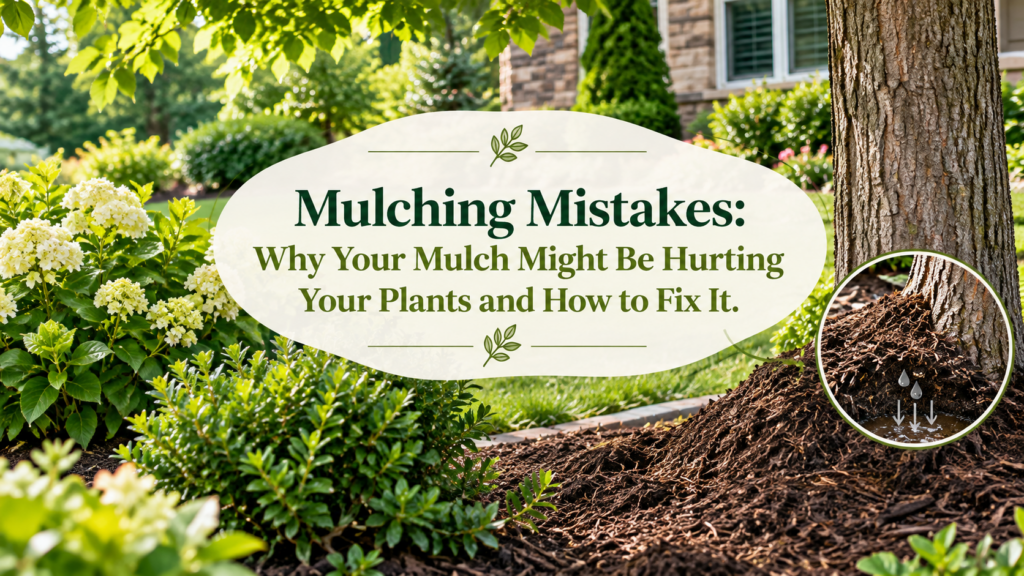
Mistake 3: Piling Mulch Against Trees Before Winter
A mound around the trunk does not give the tree a protective winter coat.
Keep the root area covered while leaving the trunk base clear.
Mistake 4: Calling All Dyed Mulch Toxic
That oversimplifies the evidence.
Current university guidance separates the colorant question from the wood-source question. The more useful concern is whether recycled feedstock contains treated or contaminated material.
Mistake 5: Expecting Mulch to Fix Drainage
Snowmelt will still follow the grade of the property.
Mulch can cover soil, but it cannot correct a low spot, blocked drainage route, or grading issue.
An Illustrative Door County Example
Consider two planting areas on the same residential property.
The front foundation bed sits beside the entrance and contains established shrubs. The homeowner wants a strong dark finish that continues looking defined into the following season.
A responsibly sourced dark dyed mulch may fit that goal.
The backyard perennial bed is less visible from the street. The homeowner cares more about natural material, gradual decomposition, and a softer appearance.
Natural shredded wood may make more sense there.
Winter protection does not require choosing one material for the entire property.
Different beds can have different priorities.
The better landscape plan treats mulch as part of the bed rather than as one product that must cover every outdoor area.
When Professional Mulching Makes Sense
A small, level bed with healthy existing mulch may need little more than weeding, raking, and a light refresh.
Larger properties become more complicated when several conditions appear at once:
- Old mulch has accumulated unevenly
- Beds need edge cleanup
- Trees or shrubs have mulch against their bases
- Material has washed downhill
- Several connected beds need matching coverage
- Spring cleanup and new mulch need to be coordinated
- Property owners are unsure how much material already remains
Ashley’s professional mulching services in Ellison Bay, WI begin with the condition of the beds and surrounding landscape rather than assuming every property requires the same amount of mulch.
When mulch care is only one part of a larger seasonal problem, Ashley’s landscape maintenance services can also address established planting areas, seasonal cleanup, pruning, and related bed-maintenance needs.
Final Thoughts: Dyed Mulch or Natural Mulch for a Wisconsin Winter?
The best winter mulch is not decided by color alone.
Dyed and natural wood mulch can both cover soil and help moderate winter temperature changes when the product fits the site and the bed is prepared correctly.
Choose dyed mulch when lasting visual consistency matters and you can confirm the wood comes from a responsible source.
Choose natural mulch when you prefer natural weathering, gradual decomposition, and a simpler wood source.
For Wisconsin landscapes, pay even more attention to depth, drainage, plant clearance, material movement, and freeze-thaw protection.
That is what determines whether a mulch bed still works when spring returns.
If your beds need attention before the next season, Ashley’s Property Maintenance LLC can review the current conditions and help determine whether the right next step is redistribution, a light refresh, or new mulch installation.
Frequently Asked Questions
Does dyed mulch hold up better than natural mulch during winter?
Dyed mulch usually has an advantage in color retention, but that does not automatically mean it provides better root protection. Winter performance depends more on material structure, bed conditions, depth, drainage, and placement than on whether the wood was colored.
What type of mulch is best for Wisconsin winters?
A well-placed organic mulch that suits the plants and bed conditions is usually more important than choosing by color. Established trees and shrubs may use shredded wood or bark, while sensitive perennials may need a separate winter-protection material recommended for that plant.
Is dyed mulch toxic to plants?
Common mulch dyes are not considered the main plant-safety concern. University guidance points instead to the possible presence of contaminated recycled wood in some products. Buy from a supplier that can explain the wood source and how treated lumber is excluded.
Does natural mulch break down during winter?
Natural wood continues weathering, although decomposition slows as soil and air temperatures fall. By spring, the surface may look lighter or more faded while usable material remains underneath. Check the actual depth before deciding whether the bed needs more mulch.
Should I add fresh mulch before winter in Wisconsin?
Only when the bed actually needs it. Inspect existing depth, clear material from trunks and crowns, remove weeds, and correct drainage problems first. Protective mulch for sensitive perennials may follow different timing and material recommendations from normal decorative wood mulch.
How deep should mulch be around established landscape plants?
The right depth depends on the plant, soil, and mulch material, so avoid treating every bed alike. The bigger rule is to avoid excessive buildup and keep mulch away from trunks and stems. Measure the existing layer before adding fresh material.
Should old mulch be removed before winter?
Usually not when it remains loose, clean, properly placed, and at a reasonable depth. Remove or thin material that has become excessively deep, compacted, contaminated, or piled against plant bases. Healthy mulch can often stay and be redistributed.
Is black mulch better for cold climates because it absorbs heat?
Color should not be your main winter-selection rule. Black mulch may absorb more solar energy when exposed, but Wisconsin winter protection depends largely on reducing rapid soil-temperature swings and maintaining appropriate coverage around roots.
Can I use dyed mulch around trees and shrubs?
Yes, provided you use a responsibly sourced product and apply it correctly. Spread mulch across the root area instead of piling it against the trunk. Keep the trunk base visible and check the existing layer before adding more material.
Is professional mulch installation worth it for a larger property?
It can be useful when several beds need preparation, old mulch has built up unevenly, edging needs attention, material quantities are difficult to estimate, or mulch work must fit into broader seasonal landscape maintenance. A property review can identify what each bed actually needs.