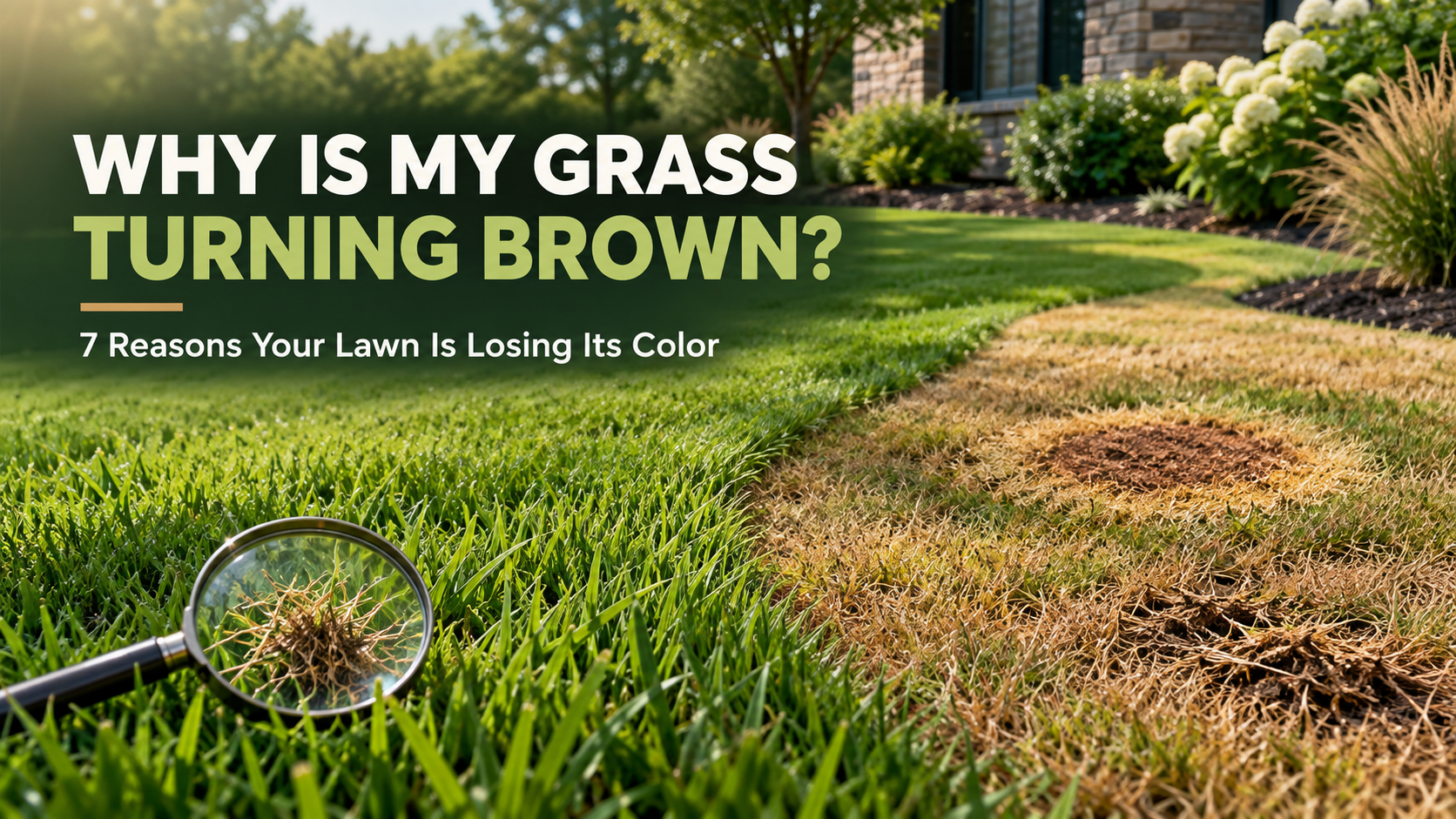
You mow on schedule. You water when it’s dry. And your lawn still has patches that look tired, thin, or turning the color of toast. That’s frustrating, because “brown grass” isn’t one problem, it’s usually one of seven, and each one needs a different fix.
Some browning is completely normal. Some of it is the first warning sign of something that gets worse if it’s ignored through the season. Telling the difference is the whole game, and it starts with looking closely at what’s actually happening under the surface.
Key takeaways:
- Brown grass has several distinct causes, seasonal dormancy, drought, disease, pests, compacted soil, poor soil chemistry, and everyday care mistakes, and each needs its own fix.
- A simple “tug test” tells you in seconds whether brown grass is dormant or dead.
- Watering deeply but less often builds stronger roots than frequent light watering, which is one of the most common lawn-care habits worth breaking.
- Catching the cause early almost always means a faster, less expensive recovery than waiting until the whole yard looks rough.
Is Your Brown Grass Dormant or Dead? Start Here
Before troubleshooting anything else, figure out which situation you’re actually dealing with. Grab a handful of brown grass and give it a gentle tug. If it pulls up easily with little resistance, that section is likely dead. If it resists and stays rooted, it’s probably dormant, a normal, temporary state, not permanent damage.
Dormancy is common with seasonal temperature shifts, and it isn’t something to panic about. It’s a normal part of the grass’ lifecycle, as Marc Mayer, director of technical operations at TruGreen, has put it, grass protecting itself, not grass dying. The tug test takes ten seconds and immediately narrows down which of the seven reasons below you’re actually dealing with.
1. Seasonal Changes Are Doing Exactly What They’re Supposed To
Grass color shifts with the calendar more than most homeowners expect, and the type of grass in your lawn matters as much as the season itself.
Cool-season grasses (like Kentucky bluegrass, fescue, and ryegrass) grow best below roughly 75°F and slow down or brown under summer heat stress. Warm-season grasses do the opposite, they thrive above 80°F and go dormant, browning, once temperatures drop in fall and winter.
Here’s how the seasons typically play out:
- Spring: A late hard freeze can damage grass that’s already actively growing, or early disease symptoms can show up.
- Summer: Dry stretches trigger drought stress, insect activity peaks, and cool-season grasses may go dormant to protect themselves.
- Fall: An early frost can hit before the lawn has fully hardened off for winter.
- Winter: Warm-season grasses go dormant as temperatures drop, a protective response, not damage.
If the browning lines up with a seasonal shift and the tug test shows resistance, you’re likely watching dormancy, not decline.
2. Your Lawn Isn’t Getting Enough Water
Drought stress shows up as browning, slowed growth, and grass that’s more vulnerable to pests and disease on top of the dryness itself. Left alone long enough, prolonged drought can also compact the soil and reduce its fertility, making recovery slower even after rain returns.
Outdoor water use makes up close to a third of the average household’s total water use nationwide, according to the U.S. EPA’s WaterSense program, which is part of why so many lawns end up under-watered during hot, dry stretches homeowners are trying to ride out efficiently.
For warm-season grasses (Bermudagrass, zoysiagrass, St. Augustine, centipede), rehydrating with consistent watering typically helps. Aim for roughly 1 to 2 inches per week, watered early in the morning two to three times weekly rather than daily.
Cool-season grasses behave differently in heat. Once they’ve gone dormant, extra water usually doesn’t bring the color back, cutting back to watering every 7 to 10 days is often the better move, keeping the plant alive until conditions cool down and it recovers on its own.
3. A Fungal Disease Has Taken Hold
Warm, humid stretches create ideal conditions for turf disease, and different fungi leave different signatures on the lawn:
- Brown patch: an irregular, blotchy patch of brown or tan grass, often after the turf has stayed wet.
- Summer patch: circular patches that start yellow and turn brown as they die back.
- Pythium blight: water-soaked patches that brown and die, sometimes with a white, fuzzy coating visible in early morning.
- Necrotic ring spot: circular brown or yellow patches ringed by a band of healthy grass.
Disease-driven browning tends to show distinct shapes, circles, rings, irregular blotches, rather than the more uniform fading of drought or dormancy. Improving air circulation and drainage, avoiding over-fertilizing, and catching symptoms early all improve the odds of a full recovery.
4. Pests Are Feeding on Roots or Blades
Grubs, chinch bugs, armyworms, and sod webworms are the usual suspects behind patchy, thinning brown spots. These insects feed on roots, stems, or blades, and the damage pattern often looks similar to disease or drought at first glance, which is why misdiagnosis is so common.
A simple check: dig a few small holes in a suspect area and look for larvae. Grubs are typically white or cream-colored and curl into a C-shape when disturbed. If the damage is light, grass roots generally start regenerating within a few weeks of treatment. Heavier damage, where most of the grass in an area is already dead, often needs reseeding or sod rather than treatment alone.
If you’re treating for lawn insects yourself, always follow the label directions exactly, including any recommended protective equipment, watering-in instructions, and reentry times.
5. Compacted Soil Is Starving the Roots
Compacted soil squeezes shut the natural channels grass roots use for air, water, and nutrients. One telltale sign: the ground feels noticeably harder than the surrounding soil, and water sits on the surface instead of draining in after rain or irrigation.
Aerating breaks that compaction open again. For larger areas, a rented core aerator or a professional aeration service covers ground efficiently. For small patches, repeatedly piercing the soil with a garden fork creates enough openings to let moisture and nutrients back through. Recovery after aeration typically takes about four to six weeks.
6. The Soil Underneath Has a Deeper Problem
Sometimes the lawn care itself isn’t the issue, the soil beneath it is. Without the right pH balance, nutrient levels, and organic matter, grass struggles to establish strong roots, and it takes far less heat or disease pressure to push a stressed lawn into browning.
A soil test, through an inexpensive at-home kit or a local extension office, shows exactly where the imbalance is. From there, lime or sulfur can correct pH, and working in compost or other organic matter improves both texture and the soil’s microbial health over time.
7. Everyday Lawn Care Habits Are Working Against You
Sometimes the cause is closer to home than a pest or a disease. The most common culprit is fertilizing incorrectly, either too little or piling on more “to be safe.” Excess fertilizer builds up as salts in the soil that damage roots directly, and damaged roots can’t pull in the water and nutrients grass needs to stay green.
Improper watering, heavy thatch buildup, and mowing too short in hot weather round out the list of everyday habits that quietly stress a lawn into browning. Cutting grass too short during peak summer heat, in particular, can cause damage that’s hard to reverse mid-season.
The 7 Causes at a Glance
| Cause | How It Looks | Typical Fix |
| Seasonal dormancy | Uniform browning tied to a season, resists the tug test | Usually resolves on its own |
| Drought | Widespread thinning and dulling, worsens without rain | Deep, less-frequent watering |
| Fungal disease | Circular, ringed, or irregular patches | Improve airflow/drainage, treat if needed |
| Pests | Patchy, spreading brown spots, larvae visible when dug | Confirm pest, treat, reseed if severe |
| Compacted soil | Hard ground, poor drainage, thin turf | Aerate |
| Poor soil chemistry | Gradual decline despite normal care | Soil test, amend pH/organic matter |
| Care habits | Salt buildup, scalped or thatchy turf | Adjust fertilizing, mowing, watering routine |
A Simple Rule for Diagnosing Brown Grass
Before assuming the worst, run through this order:
Do this: start with the tug test to rule dormancy in or out. It costs nothing and immediately narrows your search.
Not that: Don’t reach for a bag of fertilizer or a pesticide as a first response. Treating the wrong cause can waste money and, with fertilizer, actually make root damage worse.
Do this: Look at the shape of the browning. Uniform and seasonal points toward dormancy or drought. Circular, ringed, or spreading patchy patterns point toward disease or pests.
Not that: Don’t wait until the whole yard looks rough to investigate. Nearly every one of these seven causes is faster and cheaper to fix when it’s caught in one section instead of the whole property.
Steps to Take When You First Notice Browning
- Do the tug test on a few spots in the affected area to confirm dormant versus dead.
- Check the soil underneath, press a finger in to see if it’s bone-dry, oddly hard, or waterlogged.
- Look for a pattern. Uniform, patchy, circular, or ringed browning each points toward a different cause.
- Dig a small test hole if you suspect pests, checking for grubs or larvae near the root zone.
- Adjust one variable at a time, watering schedule, mowing height, or fertilizing routine, rather than changing everything at once.
- Reassess in two to three weeks. Most causes show visible improvement or a clearer diagnosis within that window.
What Homeowners Get Wrong Most Often
The single most common mistake is treating every brown patch the same way, usually by watering more. Extra water helps drought-stressed warm-season grass, but it does nothing for dormant cool-season grass, disease, or pest damage, and it can actively worsen fungal problems by keeping the turf wet.
A close second: mowing too short during a heat wave “to get ahead of it.” Scalping a stressed lawn in summer removes the leaf tissue the grass needs for recovery and often makes browning worse instead of better.
Do this, Raise your mower height during hot, dry stretches to protect stressed grass. Not that, Don’t mow shorter in summer heat, thinking it’ll mean less mowing overall.
A Realistic Scenario
Picture a property with one section of lawn near the back tree line that’s browning in an irregular, spreading pattern, while the rest of the yard, closer to the driveway, still looks green and healthy. Watering more won’t help here, since the rest of the lawn is getting the same rainfall and irrigation.
That kind of uneven, spreading pattern, healthy grass right next to visibly stressed grass under the same watering and mowing routine, is a strong sign of pests or disease rather than a watering or seasonal issue, and it’s worth digging a test hole or getting a closer look before treating anything.
When a Second Look Makes Sense
Most of the seven causes above are diagnosable and fixable from your own yard. But a few situations are worth a second set of eyes, when the cause isn’t obvious even after checking soil, patterns, and watering, when a fungal disease needs positive identification before treatment, or when a lawn has multiple issues layered on top of each other.
Ashley’s Property Maintenance LLC has worked with residential and commercial lawn care needs throughout Ellison Bay and Door County since 2010, reviewing each lawn’s actual growing conditions before recommending an approach, rather than applying the same routine to every yard. If your beds and lawn are both showing signs of stress, landscape care often needs a look at the same time, since compacted or poor soil rarely stops at the lawn’s edge.
Final Thoughts
Brown grass isn’t a single problem with a single fix, it’s seven different possibilities, and the right response depends entirely on which one you’re actually facing. Dormant grass needs patience. Drought-stressed grass needs a smarter watering routine. Disease and pests need identification before treatment. Compacted or poor soil needs amending, not more fertilizer.
The tug test, a close look at the pattern, and a quick check of the soil underneath will point you toward the right cause faster than guessing ever will. Catch it early, treat the actual cause instead of the symptom, and most lawns bounce back well before the season is over.
If your lawn’s browning has you stuck between two or three possible causes, or the usual fixes haven’t worked, Ashley’s Property Maintenance LLC can take a closer look and help you figure out what’s actually going on underneath.
Ready for a Second Opinion on Your Lawn?
If you’ve run through the checks above and you’re still not sure what’s behind the browning, Ashley’s Property Maintenance LLC can take a look and help pin down the actual cause before it spreads further. Share what you’re seeing and roughly when it started, and we’ll help you figure out the right next step for your lawn. Get in Touch →
FAQs
Why is my grass turning brown even though I’m watering it?
Watering doesn’t fix every cause of browning. If the real issue is disease, pests, compacted soil, or cool-season dormancy, extra water won’t help and can sometimes make fungal problems worse by keeping the lawn wet.
How do I know if my grass is dead or just dormant?
Use the tug test: grab a handful of brown grass and pull gently. If it comes up easily, it’s likely dead. If it resists and stays rooted, it’s probably dormant and will recover on its own.
How much water does a lawn need in summer?
Most lawns need roughly 1 to 2 inches of water per week during hot, dry stretches, ideally applied deeply and less frequently rather than in short daily waterings, which encourages shallow, weaker root systems.
What does brown patch disease look like on grass?
Brown patch typically appears as an irregularly shaped area of brown or tan grass, often developing after the lawn has stayed wet for an extended period. It’s one of several fungal diseases that can be confused with drought stress.
Can lawn pests cause brown grass even if I’m watering and mowing correctly?
Yes. Grubs, chinch bugs, armyworms, and sod webworms feed on roots, stems, or blades regardless of how well the lawn is otherwise cared for, and the resulting brown patches can look similar to drought or disease damage.
How long does it take a lawn to recover from compacted soil?
After aerating, most lawns show noticeable recovery within about four to six weeks, as roots regain access to the air, water, and nutrients that compacted soil had been blocking.
Is it normal for grass to turn brown in winter?
Yes, for warm-season grasses. They go dormant and brown as protection once temperatures drop, which is a normal seasonal response rather than a sign of damage.
Should I fertilize my lawn if it’s turning brown?
Not automatically. Over-fertilizing is a common cause of browning itself, since excess nutrients build up as salts in the soil and can damage roots. A soil test is a more reliable starting point than adding more fertilizer.
Does Ashley’s Property Maintenance offer lawn care in Ellison Bay and Door County?
Yes. Ashley’s Property Maintenance LLC provides lawn care for residential and commercial properties throughout Ellison Bay and Door County, reviewing each lawn’s specific conditions before recommending an approach.
When should I stop troubleshooting a brown lawn myself and ask for help?
If the cause isn’t clear after checking the pattern, soil, and watering routine, or if a fungal disease needs positive identification before treatment, it’s a reasonable point to bring in someone who reviews lawns regularly for a more specific diagnosis.